Mausoleo de Fernando de Valdés Salas

Cultural Route

Fernando de Valdés Salas

A journey through the life of the Inquisitor General who left a mark on the history of Spain

Introduction

Fernando de Valdés Salas was one of the most influential figures of the Spanish 16th century. Inquisitor General, Archbishop of Seville, and advisor to Charles I and Philip II, his life is closely tied to key moments in the history of Spain.

Timeline

Chronology of the main events in the Inquisitor's life

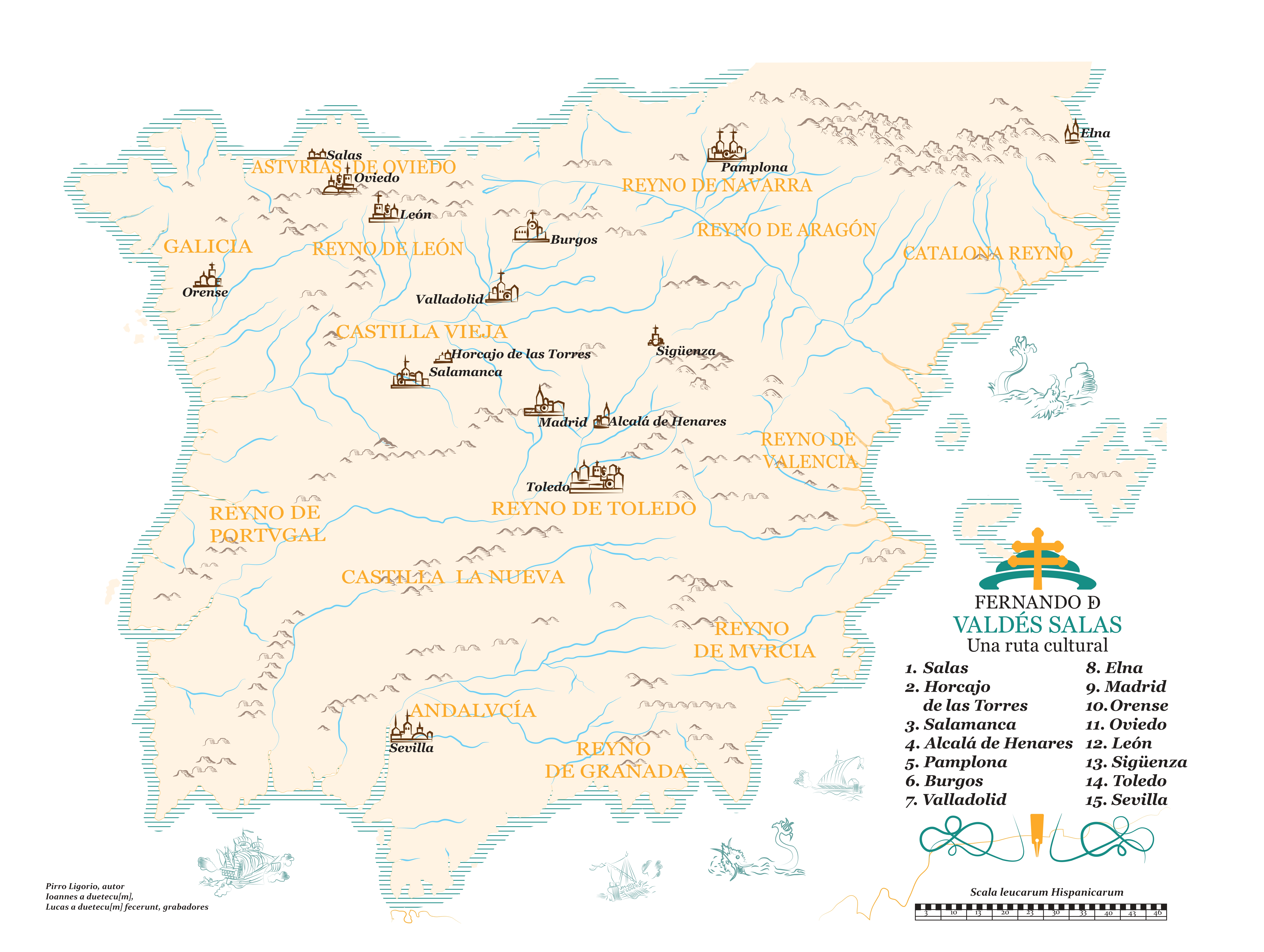
1. Salas

Birth

Fernando de Valdés was born in the town of Salas in 1483, son of Juan Fernández de Valdés and Mencía de Valdés, lords of Salas. He belonged to a family of hidalgos connected to the most important houses of the Principality of Asturias, although of moderate economic means. Probably a second son, he left his homeland early to study in Salamanca.

The Town of Salas

Description of the medieval town of Salas where the Inquisitor was born.

Collegiate Church and Mausoleum

Fernando de Valdés commissioned the construction of the Collegiate Church of Santa María la Mayor as a family pantheon, a Gothic-style temple with Renaissance elements declared a Site of Cultural Interest. His mausoleum, made of alabaster between 1576 and 1582 by Italian sculptor Pompeo Leoni at the request of the Duke of Alba, is a Renaissance masterpiece. The sculptural ensemble has three tiers: the lower one with biography and family coat of arms; the central one with allegories of Charity and Hope flanking the Archbishop in prayer; and the upper one with Faith triumphing over Heresy, alongside the virtues of Prudence, Justice, Temperance, and Fortitude.

2. Valladolid

Congregation of Valladolid

In 1527 he participated in the Congregation of Valladolid, an assembly convened to examine and censor the works of Erasmus of Rotterdam. This participation marked the beginning of his opposition to Erasmism, a movement that had gained great influence among the intellectuals of the Peninsula. That same year he was appointed Dean of Oviedo Cathedral.

Royal Council

He was appointed President of the Royal Council of Castile in 1539, a position from which he managed affairs of state during the absences of Charles V. He was responsible for maintaining harmony among the King's ministers, taking extraordinary measures during years of famine, protecting ecclesiastical benefits, and defending the coasts against piracy.

Inquisitor General

He was appointed Inquisitor General of Spain in 1547 by Philip II. He published the Index of Forbidden Books in 1559, which included works by Erasmus, Fray Luis de Granada, Juan de Ávila, and even Francisco de Borja. In 1561 he issued the Instructions for the Holy Office, which established the operating rules of the Inquisition. During his tenure he led the major trials against the Lutheran communities of Valladolid and Seville between 1558 and 1562.

Royal Chancery

He served in the Royal Chancery of Valladolid.

3. Salamanca

San Bartolomé College

He entered the prestigious Colegio Mayor de San Bartolomé in 1512, an institution known as "the ancient one" or "the old one," and the most prestigious of the major Spanish colleges. He served as rector between 1514 and 1515, and as professor of Canon Law. This college was the gateway to ecclesiastical and political power, and it was there that he began to establish ties with the circle of Cardinal Cisneros.

San Pelayo College

He founded the Colegio de San Pelayo in 1556, known as "los verdes" (the greens) due to the color of their academic robes. This college was established to host Asturian students at the University of Salamanca and became an intellectual center for the region. The institution remained active for centuries, training generations of illustrious Asturians.

4. Alcalá de Henares

Cardinal Cisneros

He served as a member of Cardinal Cisneros's council until 1517, participating in the preparation of the constitutions of the Colegio de San Ildefonso, signed on October 17, 1517. He was trained in the humanist circle of the Cardinal, where he developed his rigorous approach to theological and ecclesiastical matters.

6. Burgos

Council of the Inquisition

In 1524 he joined the General Council of the Inquisition, known as the Suprema. In 1525 he participated in the examination of cases related to witchcraft, where he doubted external phenomena while believing that internal pacts with the devil deserved punishment. This marked the beginning of his career as an inquisitor, which would culminate in his appointment as Inquisitor General.

7. Elna

Bishop of Elna

He was appointed Bishop of Elna on May 24, 1529, his first episcopal appointment. This diocese in the Roussillon, then belonging to the Crown of Aragon, was a small but significant bishopric. He held the position for only about eight months before being promoted to Ourense.

8. Ourense

Bishop of Ourense

He was transferred to the Diocese of Ourense on January 12, 1530. According to historian González Novalín, he only made a brief visit to the diocese, as his obligations at court prevented prolonged stays. This transfer represented a step up in ecclesiastical hierarchy, bringing him closer to his homeland.

9. Oviedo

Recoletas College

He founded the College of the Recoletas in Oviedo.

San Gregorio College

He founded the Colegio de San Gregorio in 1534, known as "los Pardos" due to the brown color of their robes. This college was dedicated to teaching Grammar and Latin, and served as the foundation for the later creation of the University of Oviedo. He also founded the Colegio de Niñas Huérfanas Recoletas for the education of orphan girls.

Cathedral

He made important donations to Oviedo Cathedral.

Funeral

Funeral rites were held in Oviedo after his death.

Student Hospital

He founded the Student Hospital to care for sick students at the future university. According to documents from 1614, the executors acknowledged that the hospital operated at a deficit: "the rents are not sufficient for the nurses, doctors, and medicines." In 1768 its revenues were merged with those of the Colegio de Niñas Huérfanas.

Bishop of Oviedo

He was appointed Bishop of Oviedo on July 1, 1532, the diocese of his homeland, which "was cause of great joy and contentment as it was the region of his birth." Although his obligations at court prevented him from residing permanently, he showed great interest in the affairs of the diocese and made numerous foundations in the city.

University of Oviedo

He ordered the founding of the University of Oviedo in his wills of 1566 and 1568, following the design by architect Rodrigo Gil de Hontañón. Construction began in 1574, but internal conflicts among the executors and the opposition of his nephew, who wished to keep the assets for himself, delayed the inauguration for decades. The university was finally inaugurated on September 21, 1608, the feast of Saint Matthew, forty years after the founder's death.

10. Horcajo

Secret Son

In Horcajo de las Torres, in the province of Ávila, lived his natural son Juan de Osorio, lord of the estate. Fernando de Valdés, despite his ecclesiastical position, recognized and supported his son, establishing him as heir to property and estates. This type of situation, though discreet, was not uncommon among high prelates of the time.

11. León

Bishop of León

He was appointed Bishop of León on May 30, 1536, a brief tenure that lasted only five months. On October 29 of that same year he was transferred to the Diocese of Sigüenza, in an ever-ascending career that reflected his growing influence at court.

12. Sigüenza

Bishop of Sigüenza

He was appointed Bishop of Sigüenza on October 29, 1536. This diocese was one of the most important in Castile, reflecting his growing accumulation of civil and ecclesiastical power. In 1539, while still holding the bishopric, he was appointed President of the Royal Council of Castile.

13. Toledo

Council of State

He served as a member of the Council of State, the highest advisory body of the Monarchy. Between 1539 and 1547 he was responsible for advising Prince Philip, the future Philip II, and took part in the regency during the absences of Charles V. His influence in Toledo was decisive for the political direction of the kingdom.

Meeting with Charles I

He had important encounters with Emperor Charles I.

14. Seville

Archbishop of Seville

He was appointed Archbishop of Seville on August 27, 1546, the richest and most influential see in Spain. He worked to reform the clergy and had tense relations with the cathedral chapter. During his tenure he pursued the Protestant communities discovered in Seville between 1558 and 1562, including the trial against Doctor Egidio, Constantino Ponce de la Fuente, and the Hieronymite monks of San Isidoro.

15. Germany / Flanders

Journey to the North

Between 1516 and 1520 he undertook important diplomatic missions to Germany, Flanders, and Portugal. In 1516-1517 he served as legal advisor (letrado) to Diego Columbus in his claims to the Indies, establishing a relationship with his brother, the bibliophile Hernando Columbus. He probably attended the coronation of Charles V in Aachen and personally witnessed the religious situation in Central Europe, an experience that would influence his later positions as Inquisitor.

16. Madrid

Death of Valdés

Fernando de Valdés died in Madrid on December 9, 1568, in a climate of disgrace with Philip II due to the handling of the case against Archbishop Carranza. His body was transferred to Asturias in a solemn procession, with celebrations in Oviedo before the final journey to the Collegiate Church of Salas, where he rests in his magnificent mausoleum.

Testament

In his testament he named his natural son Juan de Osorio as heir, which gave rise to numerous lawsuits with the ecclesiastical institutions. Throughout his life it is estimated that he distributed about 600,000 ducats in alms and pious foundations, an extraordinary sum that shows both his wealth and his concern for leaving a lasting legacy.